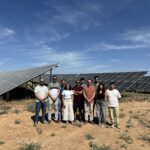

Ingelectus has completed phase 2, the final phase, of the DT4Flex project carried out together with Cuerva, Bamboo Energy and Smart City Cluster. DT4Flex represents an important step forward in grid management technology, as it is a low-voltage digital twin consisting of a tool capable of predicting short-term events and assessing the availability of flexibility services to solve resulting problems, thus maximising the safe penetration of new players.
Over the year of work that made up the second active phase of the project, the tool has been optimised to incorporate the resolution of new issues, such as neutral conductor congestion through the activation of flexibility resources. A load and generation forecasting module at user level has also been developed using different artificial intelligence techniques, enabling the tool to anticipate future incidents.
Rubén Carmona, the project manager, stated that “DT4Flex has helped us tackle many highly relevant challenges, including digital twins that faithfully represent low-voltage behaviour, the design of the communication architecture between agents in local flexibility markets, the extension of CIM models for flexibility in distribution, as well as the processing of Cuerva’s grid data to develop a PoC.”
The operation of DT4Flex has been validated on the low-voltage networks of several transformer substations within Cuerva’s living lab, using real data from advanced low-voltage monitoring and the smart meters installed there. It is worth noting that the tests took into account both current and future scenarios, so that capabilities have been estimated based on different realistic and possible characteristics, both of the resources and of the scenarios.
Results
During the execution of this project, various major technological challenges have arisen, which Ingelectus has been able to solve, as well as answering key questions such as how flexibility resources in low-voltage networks should be distributed, located and configured, or what level of photovoltaic penetration these networks can host. The results obtained are highly satisfactory:
-
Increased level of observability of the low-voltage network, both in terms of operating state and the mutual influence between nodes and service lines.
-
Improved accuracy in the electrical knowledge of network behaviour.
-
Formulation of a linear, deterministic optimisation problem with reduced convergence times and based on the physics of the grid.
-
Implementation of deep learning techniques for a problem that is critical for DSOs: predicting the future behaviour of their networks.
-
Evolution of the tool towards a microservices-based architecture that enables its deployment and scalability in any environment.
-
Design of a methodology that takes into account the electrical impact of flexibility in order to identify influence areas where it is most advantageous to locate flexibility resources.
-
Development of an extension of the tool that allows the photovoltaic hosting capacity of low-voltage networks to be calculated.
-
Inclusion of the economic criteria associated with the cost of activating flexibility services, so that the solution is not only optimal from a technical point of view, but also the most profitable option.
The validation of the DT4Flex tool in a relevant environment such as Cuerva’s living lab has paved the way for its application in any computing environment. It should also be stressed that “understanding the possibilities offered by flexibility service providers and simulating the requirements that will be imposed on them to participate in grid management are aspects that will help DSOs effectively handle future scenarios,” explained Rubén Carmona.
In the same line of results, DT4Flex will enable distribution system operators to carry out their actions with a high degree of accuracy, ensuring that the participation of flexibility resources in grid management takes place on equal terms and that the outcomes delivered by the tool respond solely to technical and economic optimisation criteria. These results confirm that investment in grid digitalisation is something DSOs must take into account in order to move forward and remain competitive in the market.