
Gathering, updating or even accessing information on the topological status of low-voltage networks can still be a challenging task for electricity distribution companies today.
In recent years, these networks have been evolving into active systems in constant flux due to various factors: new customer connections or disconnections; the integration of new players such as electric vehicles or distributed PV generation; scheduled work on the grid; or topology changes triggered by faults that must be resolved as quickly as possible.
It is also only recently that knowledge and digitalisation of low-voltage networks has become a priority for DSOs. As a result, the grid information stored in databases is often outdated or, in many cases, simply does not exist. This is evident, among other things, in the lack of available information on the low-voltage meters’ electrical chain.
Towards a new concept of distribution networks
Electricity distribution networks are undergoing most of the technological evolution currently taking place in the power sector, mainly driven by the need to accelerate the energy transition.
With the goal of Smart Grids firmly on the roadmap of major DSOs, the digitalisation of their assets has become a long-distance race that has only just begun. For this reason, it is easy to see the opportunity this represents for the development of innovative electrical solutions that help drive this transformation.
These solutions must not only consist of hardware systems for control or measurement devices, but also of tools capable of adding intelligence to them and using the vast amount of collected data to generate knowledge that brings real value to the DSO’s day-to-day operations.
Harnessing the huge volume of data generated in low-voltage networks
Along these lines, Ingelectus has been working for years on projects aimed at smart distribution networks. In recent years, specifically, products such as InCharta have been developed: a tool tailored to the operational reality of DSOs and capable of answering the question of where and how their customers are connected.
-
It resolves the meter’s full electrical chain: starting from an initial pool of meters, it identifies the transformer, low-voltage feeder and phase to which each of them is connected.
-
It determines phase-by-phase consumption distribution for unbalanced three-phase meters.
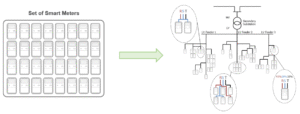
Illustrative diagram of how InCharta works
InCharta’s architecture has also been designed to operate autonomously and in sync with the DSO’s systems. This makes it possible both to periodically update the network topology, turning it into a “living” system, and to handle specific identification requests submitted by the grid operator.
All this has been achieved after several years of research to thoroughly understand the problem and through the application of artificial intelligence techniques such as machine learning and neural networks. This tool, developed and validated in Ingelectus’ laboratory as part of the PASTORA project funded with ERDF funds, has also been validated in a real-world environment: e-Distribución’s Living Lab, Smartcity Málaga.
Starting point for Smart Grid applications
The results provided by InCharta not only make it possible to correctly locate loads in the network, but also generate key insights for Smart Grid applications. Among these, the following can be highlighted:
InCharta, one of the applications in the Ingrid platform developed by Ingelectus
In addition, InCharta is part of Ingrid, a suite of applications designed to support the operation, planning and maintenance of distribution networks. Alongside InCharta, this platform includes other applications focused on the monitoring, planning and optimisation of HV, MV and LV networks.
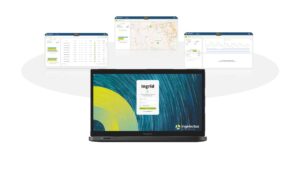
Esquema ilustrativo del funcionamiento de InChartaFinalmente, en Ingelectus estamos completamente convencidos de que la digitalización de la red va más allá de la mera instalación de sensores en los activos de red, y que la única forma de alcanzarla es trabajar conjuntamente con las compañías distribuidoras, poniendo a su servicio aplicaciones disruptivas como InCharta o la plataforma Ingrid.