
Looking to update our work management approach
In recent years, Ingelectus has taken a step forward in its work management methodology. The need to be more adaptable and efficient in product development has encouraged the team to adopt new management approaches. As a result, the company has reached a more optimal way of working that has been key to successful product development.
Given the wide range of work management approaches available, the team asked itself:
“What is the best approach for us?”
There is no perfect solution, but there are methods that are better suited to the team, the product to be developed or the circumstances. Ingelectus tried Agile and obtained very good results.
Why an Agile approach?
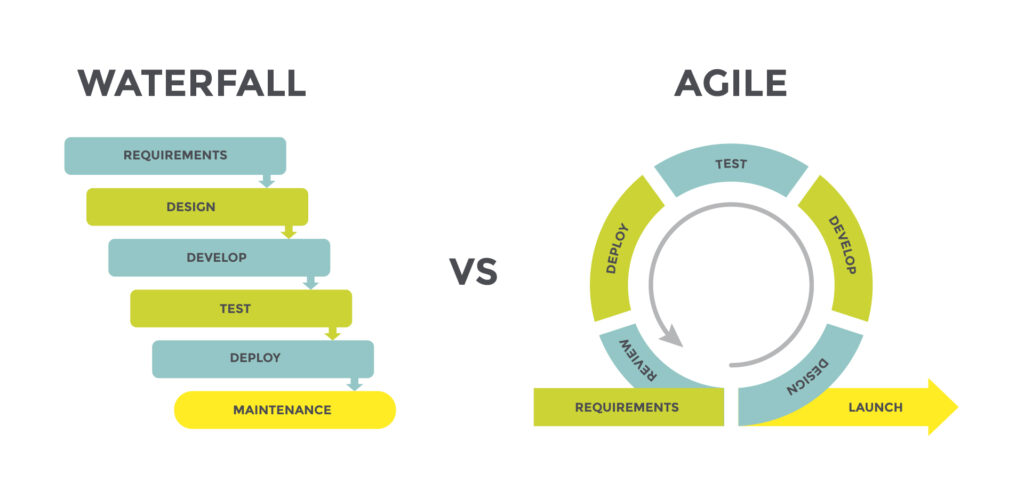
The intense effort devoted to product development must be accompanied by proper management. The company works on products that are mainly software-based, which means that conventional management techniques (such as the waterfall model) are less efficient and do not fit particularly well. Instead, Agile approaches are widely recommended in the literature. Agile is designed to adapt the way of working to the conditions of a software project: it is an iterative and incremental approach.
While working on product development, the team realised that product requirements often changed or new ones were requested. It was clear that these conditions required a flexible working methodology and frequent interactions with the customer.
That is what Agile approaches offer: a working methodology based on incremental deliverables that are refined through an iterative process. Since their emergence, these approaches have evolved into increasingly effective versions for the success of software projects.
Choosing the Agile approach
Among the different Agile approaches, the company has opted for Scrum, which is the predominant agile method for software development. Scrum is based on three main pillars: transparency, inspection and adaptation. In this approach, iterations are called sprints, and the incremental work items are organised in sprint backlogs.
The key point in Scrum is that it provides a framework with clear events and roles designed to apply these three pillars and deliver valuable product increments. This approach allows the company to improve the product in each sprint while at the same time enhancing team interaction and the working environment. This is why Scrum is also used in projects that are not purely software-based, or in hybrid form alongside other approaches.
Managing new products through Scrum
Ingelectus is widely applying Scrum to develop its new products. This adoption has been gradual and has been strengthened as staff have gained experience with the approach and product development has delivered results. To make this integration possible, Ingelectus decided to train its team in the Scrum framework.
The company is currently working on several projects using Scrum. Through these projects, staff have learned to perform all three Scrum roles and to take on different roles depending on the project. This enables the team to understand the perspective and responsibilities associated with each role. This approach also involves integrating Scrum events into the company’s working methodology, such as the sprint and the daily Scrum.
By applying Scrum, the team is encouraged to be more proactive and self-organising. This approach does not aim to appoint a single leader to manage the project and assign tasks to the team, as conventional management techniques do. In this case, the roles are somewhat different, and the working methodology is designed for a self-organised, cross-functional team. After some time working with Scrum, the company can say:
“We have improved our teamwork, becoming more proactive and well organised.”
Encouraging others to use Scrum
Choosing this approach does not only mean having a Scrum team, but also Scrum customers. Working with a company to improve or continue a product that has been developed under a Scrum framework creates the need for a “Scrum customer”. This would allow the team to maintain the framework that was applied from the very beginning of the product.
This consideration raises some questions: Is it easy to integrate Scrum within a company? Would it be possible to apply a hybrid Scrum approach when companies with different methodologies work together?
For Ingelectus, the integration of Scrum has been a key factor in product development and has strengthened the company’s working methodology. Today, staff continue to work enthusiastically on the implementation and integration of Scrum. Ingelectus’ goal is to choose the best approach for each project and customer, and in doing so, achieve an optimal way of working on the innovative electrical solutions it delivers.