The key role of smart electricity distribution grids arises from today’s global context. The outlook for the power sector is as promising as it is ambitious. National and European energy policies – in particular the 2015 Paris Agreement – have helped shape this vision. This agreement, whose main objective is to join forces to tackle climate change, focuses on two key aspects: achieving net-zero emissions by 2050 and placing people at the centre of the energy transition.
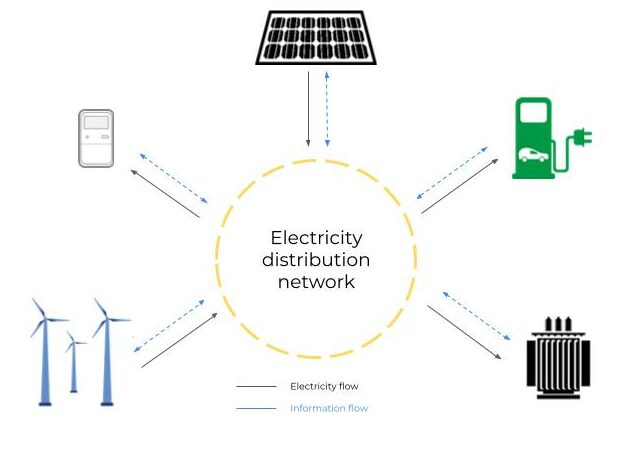
In practice, these goals call for radical changes to the energy model as we know it and will require the cooperation of all the necessary mechanisms: distributed generation, electric vehicles, energy communities, self-consumption, flexibility markets, distributed storage and active demand-side management. Each of these elements has, on its own, been the subject of research over the last decade by the academic community and the main players in the sector. However, recent progress has also focused on what they all have in common: the electricity distribution grid.
Smart distribution grids at the heart of change
It is clear that electricity distribution grids are the connecting link between all the new stakeholders in the sector, the infrastructure to which they are connected and the main enabler of their functions. They connect cities and people, supply power to hospitals and airports, allow you to charge your electric vehicle or feed in your surplus generation. Without a smart distribution grid that is adapted to these new players, there will be no energy transition.
However, following the advances of recent years, managing these new distribution networks not only involves controlling electrical assets, but also handling the communication, storage and subsequent exploitation of the vast amount of data generated within them.
The entire data ecosystem now emerging around distribution grids should not be seen as an obstacle, but as the essential foundation for deploying true smart grids.
Digitalising assets, embedding intelligence into every process and defining data-driven control strategies are the three pillars on which this transformation must be built. In this way, Big Data tools and Artificial Intelligence will become practical solutions for the grid as a whole, rather than merely pilot projects in controlled environments.
At Ingelectus, we are fully aware of this challenge and, for the past six years, have devoted our efforts and team to researching and developing innovative solutions in this field. Projects such as MONICA and PASTORA, which address in detail grid monitoring and the implementation of AI algorithms in the network; innovative technologies such as Medium- and Low-Voltage State Estimation, which is key to monitoring smart grids; new products developed by Ingelectus, such as the InGrid Platform; and our close collaboration with the School of Engineering at the University of Seville all clearly demonstrate Ingelectus’ commitment to playing an important role in this green revolution.